Latest Videos from World News By BCJP TV

Monks protest across Myanmar to demand formal apology for violent crackdown on mine protesters

[postlink] https://burmacampaignjapanteam.blogspot.com/2012/12/monks-protest-across-myanmar-to-demand.html [/postlink]
YANGON, Myanmar — Buddhist monks across Myanmar have peacefully demonstrated to demand a formal apology from the government for its recent crackdown on protesters at a copper mine that injured more than 100 of their monastic colleagues.
Hundreds of monks in Yangon and Mandalay, the country’s two biggest cities, along with Monywa, the town closest to the mine, and at least six other towns marched in protest Wednesday as security forces stood by without interfering.

Police used water cannons, tear gas and smoke bombs on Nov. 29 to break up an 11-day occupation of the Letpadaung mine project, a joint venture between a military-controlled holding company and a Chinese mining company. Protesters want the project halted, saying it is causing environmental, social and health problems.
 

Exile media crafting new role from inside Myanmar

[postlink] https://burmacampaignjapanteam.blogspot.com/2012/12/exile-media-crafting-new-role-from.html [/postlink]
This picture taken in August 2012 shows a newspaper vendor in Yangon. Their journalists risked jail terms to report inside Myanmar under years of brutal junta rule, but once-exiled media now operate openly -- and face flak for being too cosy with the new leaders.

YANGON (AFP)

Their journalists risked jail terms to report inside Myanmar under years of brutal junta rule, but once-exiled media now operate openly -- and face flak for being too cosy with the new leaders.
In a dramatic change of fortunes, the Democratic Voice of Burma (DVB), the Irrawaddy website and Mizzima News agency have all set up offices in Yangon, lured back by the reforms their journalism helped engender.
And this week a free copy of The Irrawaddy magazine will hit newsstands in Myanmar's major cities for the first time since it was founded two decades ago.
It is a move that the organisation says will test the new quasi-civilian government's commitment to change in the country, as the former pariah state undergoes sweeping reforms.
"This is the first time we got permission from the government to distribute the magazine inside the country," Kyaw Zwa Moe, editor of The Irrawaddy's English edition, told AFP, adding that the publication would continue to be "quite critical".
The Irrawaddy and DVB have long operated from bases in northern Thailand as they tried to report on the secretive junta from exile overseas.
But now journalists -- among them former political prisoners -- are received by high officials in the government which replaced the disbanded junta in 2011.
"Before, I never slept well. I could be arrested... it could happen anytime," said Hla Hla Win, a DVB video reporter who spent two-and-a-half years of a 20-year sentence in jail before her sudden release in January along with other political prisoners.
"I've been surprised by the new administration, I never imagined they would allow such things... they are more soft dealing with journalists."
Under military rule the Oslo-based DVB was every day accused by the state-run press of spreading "killer broadcasts", along with the BBC and other foreign media.
But the news organisation, which boasts an audience of five million, recently opened a downtown office and although it did so under an assumed name and in a discreet apartment, its journalists no longer work in secret.
Myanmar has taken significant strides towards greater press freedom.
Censorship was abolished in August and pictures of opposition leader Aung San Suu Kyi and US President Barack Obama adorn the front pages of magazines and journals which now dare to report on former no-go areas such as corruption.
Media groups, enticed to return by the new freedoms, now face the challenge of crafting an independent voice from inside the country without compromising reputations for courageous reporting they earned in exile.
Critics are already grumbling that they are diluting their once fearless journalism.
"I am disappointed to see that these 'transplanted' exiled media are practising too much self-censorship now," said Maung Maung Myint, of the Burma Media Association, which represents exiled journalists.
"In some cases, they have lost their impartiality... The government is definitely playing with them," he added.
Maung Maung Myint cited DVB-led seminars on public broadcasting for the Ministry of Information as an example of the group's warm relationship with the powers that be.
The DVB, which will probably close its office in Oslo but keep studios in Thailand, vigorously defends its editorial independence, arguing that by speaking to once-secretive ministers and army officials, its journalism has become more balanced and accurate.
"In the past, as in every closed society, most 'news' was rumour and it was very difficult to check the story or hear different voices," said DVB editor Aye Chan Naing. "That is not the case any longer."
But he recognised that talking to a government which once considered them "as enemies" -- so much so it arrested 17 DVB journalists -- could be seen as "controversial".
The Irrawaddy, in an effort to preserve its editorial independence, has also adopted a "one foot in, one foot out" strategy by maintaining its base in Thailand, according to its editor Aung Zaw.
"Our critical reporting style, approach to stories and editorial position have remained the same," he said, adding the outlet is "not mouthpiece of activists, opposition or the regime".
Myanmar, also known as Burma, is still far from meeting the criteria of a free press.
A Reporters Without Borders map pinned to a wall in DVB's office shows the country coloured in black, an ignominious distinction shared notably by North Korea and Iran.
Some journalists have been prosecuted for their stories, although none has been arrested recently.
Kyaw Zwa Moe said The Irrawaddy was "just testing the waters" with the one-off issue this week, both in terms of the appetite for the publication from readers and the political situation.
He said it was important to maintain the organisation's Thai office because "things can change".
"Things are not certain yet in Burma, especially the reform process."

Burmese government apologises to injured monks

[postlink] https://burmacampaignjapanteam.blogspot.com/2012/12/burmese-government-apologises-to.html [/postlink]
 
 
Photo: Buddhist monks and supporters rallied in support of the monks who were injured in the mine riot (Reuters: Soe Zeya Tun)
 
Burma's state media says the government has apologised to senior Buddhist clerics over injuries sustained in a violent police crackdown on a rally at a Chinese-backed copper mine.
The religious affairs minister Myint Maung said the incident at the mine was a "great grief", he but stopped short of apologising for the crackdown itself.
The sit-in by farmers and activists outside the Monywa copper mine had already attracted nationwide interest as a test of Burma's political openness before the police moved in to disperse them.
The operation resulted in at least 99 monks and 11 others suffering wounds including severe burns.
At a ceremony with some of the country's top clerics, Mr Maung "begged the pardon of wounded monks and novices", blaming the "incompetency" of the authorities, according to a report in state newspaper New Light of Myanmar.
However he said the demonstration had a "political" element and that the government was treating the wounded with a "clear conscience".
The pre-dawn raid on protest camps at the mine last month was the toughest clampdown on demonstrators since a reformist government came to power last year.
Human rights groups condemned it as reminiscent of the methods used by Burma's former military rulers.
About 100 police apologised to a group of monks in Monywa soon after the crackdown, but the move failed to calm the public mood.
Around 150 people and 40 monks marched through Rangoon on Saturday to protest the Monywa violence, the latest in a string of street demonstrations in the country's commercial hub and in the second largest city Mandalay in recent days.
"The monks are denouncing the brutal crackdown," Ye Min Oo, an activist at the rally, said.
"Many monks welcome the officials' apologies. But they also want them to say sorry in person to the injured monks."
Opposition leader Aung San Suu Kyi has been appointed by the government to lead a probe into the incident, as well as claims of evictions and pollution at the mine.
Earlier this week she said it was not yet clear what had caused the demonstrators' injuries, but suggested tear gas could be to blame.
The dispute at the Monywa mine centres on allegations of mass evictions and environmental damage caused by the project - a joint venture between Chinese firm Wanbao and military-owned Myanmar Economic Holdings.
Activists are calling for work at the project to be suspended to allow impact studies to be carried out, but China insists that the contentious points have already been resolved.
Several people are being held without bail at Rangoon's infamous Insein prison over their involvement in other protests against the mine.
According to the New Light of Myanmar, Bhaddanta Kumarabhivamsa, one of the country's most senior monks, called upon all parties to ensure such incidents do not happen again "and try their utmost to behave themselves".

BBC/AAP

Burmese president cancels Australian visit

[postlink] https://burmacampaignjapanteam.blogspot.com/2012/12/burmese-president-cancels-australian.html [/postlink]
AP © Myanmar's president has cancelled plans to visit Australia next week due to domestic commitments.

Myanmar's (Burma) reformist president has cancelled plans to visit Australia next week.
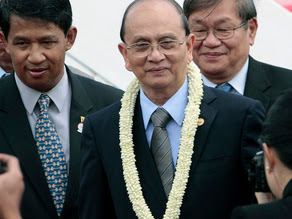
Thein Sein was due to visit Canberra and Sydney at the federal government's invitation next Monday and Tuesday.
But a spokesman for Prime Minister Julia Gillard on Thursday said the former military general turned civilian ruler had decided to postpone the trip.
"The Australian government was advised late yesterday that the president would be postponing his visit to Australia owing to domestic commitments," he said.
"We very much look forward to welcoming the president to Australia at a mutually convenient time in 2013."

http://au.news.yahoo.com/thewest/a/-/national/15571929/

Myanmar mine protesters denied release on bail

[postlink] https://burmacampaignjapanteam.blogspot.com/2012/12/myanmar-mine-protesters-denied-release.html [/postlink]


YANGON, Myanmar—Demonstrators who protested peacefully against a mining project in northwestern Myanmar have been charged under a law that denies them release on bail.
Aung Thein, the lawyer for two of six activists arrested last week in Yangon, said Tuesday they were charged for inciting unrest, a criminal offense that carries a maximum sentence of two years' imprisonment. The activists' trial began Monday.
Aung Thein said the authorities could have taken action under the peaceful assembly act, which allows street protests if a permit is obtained.
Police last Thursday cracked down on protesters occupying part of the Letpadaung copper mine, which critics claim causes environmental and social damage. Dozens of protesters, including Buddhist monks, suffered burns caused by an incendiary riot-control device.

The Associated Press

Blind China dissident urges Xi follow Myanmar path to reform

[postlink] https://burmacampaignjapanteam.blogspot.com/2012/12/blind-china-dissident-urges-xi-follow.html [/postlink]
 
 
BEIJING (Reuters) - Blind Chinese activist Chen Guangcheng has urged Communist Party chief and president-in-waiting Xi Jinping to follow Myanmar's model of reform or risk a violent political transition.
Chen also accused the government of breaking a promise to investigate what he says is the persecution of his family, according to a recorded message posted on YouTube by Texas-based Christian advocacy group ChinaAid, which backs him.
The self-taught legal advocate's escape from house arrest in April and subsequent refuge in the U.S. Embassy was deeply embarrassing for China, and led to a diplomatic tussle between the two countries.
Chen was allowed to leave China and is studying in New York.
Chen said in the message released over the weekend that if Myanmar's President Thein Sein was able to release people like Nobel laureate Aung San Suu Kyi, then Xi should be able to release Chinese prisoners of conscience.
"Then Sein's open mind won him support from Myanmar's people and recognition from the world. Even Thein Sein can do it, yet Xi Jinping doesn't. Obviously it's not that Xi couldn't do it, but simply that he won't," Chen said.
Chen's nephew, Chen Kegui was given a three year three month jail term last week after being charged with using knives to fend off officials who burst into his home on April 27, the day after they discovered his uncle had escaped from 19 months of house arrest in eastern Shandong province and fled to the U.S. Embassy in Beijing.
"Because I fled the country, government officials have enacted revenge on my nephew Chen Kegui and others. Chen Kegui tried to defend our family, but he was arrested and is still in jail today," Chen Guangcheng said.
"There is no word that Communist Party rulers are willing to change and do the right thing," Chen added.
Addressing Xi, he said: "Whether you will follow the call of heaven and the people to carry out reform, or kidnap the government and maintain the power of the Communist Party is a matter of whether China will have the transition in a peaceful way or a violent way".
The U.S. State Department said it was deeply disturbed by Chen Kegui's sentence.
But Chinese Foreign Ministry spokesman Hong Lei said the United States had no business interfering in the issue.
"The Chen Kegui case is solely a Chinese domestic matter. China is country with rule of law ... The legal rights of this person and his family members have been effectively guaranteed," Hong told a daily news briefing.
"We are extremely dissatisfied that the relevant country rudely interfered in China's internal affairs. We most certainly do not accept it."
(Reporting by Ben Blanchard; Editing by Robert Birsel)

Suu Kyi to lead Myanmar copper mine probe

[postlink] https://burmacampaignjapanteam.blogspot.com/2012/12/suu-kyi-to-lead-myanmar-copper-mine.html [/postlink]
 
Photo by Ye Aung Thu/AFP
 
Myanmar opposition leader Aung San Suu Kyi will lead a probe into a crackdown on a protest against a Chinese-backed copper mine which will also assess the future of the contested project, the president's office said on Saturday.
The 30-strong non-parliamentary commission will investigate the "social and environmental issues" behind the protests -- which include allegations of mass evictions to make way for the mine.
The Nobel laureate has sought to mediate an end to the stand-off at the mine in Monywa, northern Myanmar, which saw scores of villagers and monks injured in the toughest clampdown on demonstrators since President Thein Sein's reform-minded government came to power last year.
Photographs of the protesters' injuries, which included severe burns, have stirred outcry across Myanmar, reminding the public of the brutal junta-era security tactics and the probe appears to recognise the depth of those concerns.
The commission will "investigate the truth" of the pre-dawn raid by riot police and assess whether the "copper mining project is being implemented in accord with international norms", a statement on the presidential office website, signed by Thein Sein, said late on Saturday.
It will also advise whether "to continue the copper mining project and whether to stop foreign investment", the statement said, without providing further details.
Activists are calling for work at the mine -- a joint venture between Chinese firm Wanbao and military-owned Myanmar Economic Holdings -- to be suspended to allow impact studies amid allegations of mass evictions and pollution.
China insists that the contentious points had already been resolved, but the dispute echoes fierce opposition to a Chinese-backed mega-dam which saw Thein Sein order the scheme's suspension last year in response to public anger.
Suu Kyi visited the area and on Friday demanded an apology for monks hurt in the crackdown, after holding talks with both sides.
But the veteran dissident struck a conciliatory tone towards China and declined to back calls for an immediate halt to work on the mine.
In a renewed sign of growing anti-China sentiment around 50 people marched to the Chinese Embassy in Yangon on Saturday.
The presidential office statement followed an apology by police for injuring monks in their crackdown on protest camps on Thursday, an AFP reporter said Saturday, but tensions over the pre-dawn raid remained high.
A senior police official among around 100 officers told a group of 10 monks that "we are sorry for what happened and apologise", according to the AFP reporter at the scene, although it was unclear if the monks accepted the apology.
With many monks still being treated in hospital, Aye Net, a protest leader in Monywa, said anger was still raw towards the police despite the apology, telling AFP "I will never forget the scenes of their crackdown".

By Ye Aung Thu | AFP – 18 hours ago
 
Support : Website | Template | Mas Template
Copyright © 2012. Burma Campaign Japan - All Rights Reserved
Template Created by Creating Website Published by Template
Proudly powered by Blogger