Latest Videos from World News By BCJP TV

The Special Agent In Charge

[postlink] https://burmacampaignjapanteam.blogspot.com/2013/04/the-special-agent-in-charge.html [/postlink]

SHANNON STAPLETON / REUTERS

Officials take crime scene photos a day after two explosions hit the Boston Marathon in Boston, Massachusetts April 16, 2013.

On Friday, July 9, 2010, FBI Special Agent Richard DesLauriers disembarked from a chartered Vision Airlines jet on the tarmac of Vienna’s Schwechat International Airport, accompanied by ten Russian sleeper agents and their families. Nearby, four Russian prisoners got off a plane that had just landed from Moscow. The two groups headed towards each other under the baking central European summer sun for a rare and unusually large exchange of captured spies. It was the culmination of what a former senior Justice Department official calls “one of the most complicated and impressive counterintelligence operations” in recent U.S. history.
Less than three years later, DesLauriers is facing a very different challenge. As Special Agent in charge of the FBI office in Boston, DesLauriers, 53, is running the Joint Terrorism Task Force investigation into the Boston Marathon attacks, the first successful terrorist bombings on U.S. soil since 9/11. The bombing is a different kind of case than DesLauriers spent his career investigating: a 25-year veteran of counterintelligence, he made his bones running operations against foreign spies, not tracking down and busting terrorists. For DesLauriers and the FBI, the Boston Marathon bombing is a high-visibility test.
Former and current colleagues at the FBI and Justice Department say DesLauriers and the FBI are up to the task, and they say the roll-up and exchange of the Russian spies, dubbed “Operation Ghost Stories,” shows it. After 9/11 the FBI was criticized for failing to coordinate with other agencies and for being stuck in a Cold War-era mind set. In the roll up of “Ghost Stories” the FBI pulled off a politically and diplomatically delicate operation that involved coordination with multiple intelligence agencies, U.S. attorney’s offices and local field agents. “Rick is the real deal,” says David Kris, former Assistant Attorney General for National Security during the Russian roll-up, “He’s very, very good, extremely methodical and organized.”
On paper, DesLauriers looks like a classic FBI Special Agent. He grew up in Longmeadow, Massachusetts, went to Assumption College in Worcester, MA, and then got a JD at Catholic University in Washington, DC—“a good Catholic boy,” says his friend and former FBI colleague John Slatterly, who worked with him in counterespionage for 15 years. DesLauriers joined the FBI as a Special Agent in 1987 and went straight into spy work. After a few years in New York and DC, he returned to Boston in 1997 ultimately supervising the FBI’s counterintelligence programs in the northeast. In March 2008, he was promoted to head the FBI’s counterintelligence operations and espionage investigations as deputy assistant director.
 After the 2008 election, DesLauriers was given the unenviable assignment of rolling up Operation Ghost Stories. The Obama administration, prodded by the powerful new CIA chief Leon Panetta, decided to deliver on a long-standing desire of the agency’s clandestine service to free four agents who had been jailed by the Russians. Looking around for something to trade for them, the administration settled on the Russian sleepers, foreign agents being watched by the FBI while operating in America.  The plan was to arrest and trade the ten Russian sleepers in the U.S. for the four agents being held in Moscow.
“The bureau had to figure out, OK, how in the hell do we play this,” says Slatterly. The case would require DesLauriers to coordinate hundreds of people in different agencies, successfully arrest the spies without alerting them beforehand, and collect enough evidence of the spies’ activities to ensure they could be convicted.
But the toughest part could have been getting FBI field agents to work with the CIA. Operation Ghost Stories was one of the FBI counterintelligence division’s biggest successes. For more than a decade, agents had been running wires and surveillance on the ten “illegals,” Russian nationals who were living and working in the U.S. under deep cover and without the protection of diplomatic immunity. “These were some of the best intelligence operatives the Russians have ever had,” says the former senior Justice Department official. And until they were arrested, they were unaware the FBI was monitoring them as passed intelligence to handlers from the Russian government.
Throughout the Cold War, the FBI and CIA famously clashed over intelligence matters, and the 9/11 Commission report found miscommunication between the agencies had contributed to missing the plot. So when the FBI counterintelligence division was told that it should roll up one of its most successful operations against unsuspecting spies, and give them a free ticket home in exchange for some captured CIA agents, not everyone was happy. Says Slatterly, “There was a broader national security equity at stake. Rick saw that and I think communicating that down to the agents in the field, everybody accepted that in the end it was a great case, despite the fact that it didn’t end with anybody sitting in jail for a real long time.”
Not all DesLauriers’ characteristics are well-suited for counterterrorism. “He comes across as a bit bookish,” says the former senior Justice Department official. Obsessed about being read into the details of the cases, DesLauriers ”could be criticized for overdoing it,” says Slatterly, meaning his friend is a bit of a perfectionist when it comes to being prepared. And where counterintelligence agents can spend years monitoring suspects without arresting them, counterterrorism cases can be rapidly changing.
But Slatterly and others say the Russian roll-up shows DesLauriers is up to managing a complicated case like the Boston bombing. FBI director Robert Mueller apparently agrees: he named DesLauriers to run the Boston FBI office on July 1, 2010, eight days before the Massachusetts native would complete the Operation Ghost Stories spy swap at the airport in Vienna.

Suu Kyi visit highlights Japan’s Burma push

[postlink] https://burmacampaignjapanteam.blogspot.com/2013/04/suu-kyi-visit-highlights-japans-burma.html [/postlink]


By Apr 12, 2013 5:11PM UTC


TOKYO (AP) — Japan’s long-deferred aspirations for a larger role in Burma are getting a boost this coming week with a visit by Nobel Peace Prize laureate and opposition leader Aung San Suu Kyi.

The visit by Suu Kyi, in Japan for the first time in 27 years, is highlighting Japan’s interest in helping to craft a blueprint for Burma’s economy and tapping its growth potential.

So far, Japan’s investments and involvement lag far behind those of China and India. But that is fast changing, after Tokyo forgave about half of Burma’s more than $6 billion dollars in debt, clearing the way for renewed international lending to the impoverished Southeast Asian country.

A high-powered delegation of business leaders, including top executives from Toyota Motor Corp., Hitachi Ltd. and Sumitomo Chemical, toured Burma, also known as Myanmar, in February and pledged to cooperate in encouraging more investment.

Although Suu Kyi is not in government, she is widely respected, especially in Japan, where she is expected to meet with Prime Minister Shinzo Abe and other top officials and give speeches at two of Japan’s most prestigious universities.

“Aside from being the opposition leader and an icon for democracy and political freedom, she is a goodwill ambassador. The idea is to encourage the Japanese government and corporate Japan to support Burma,” said Jeff Kingston, a professor at Tokyo’s Temple University.

The handover of power by Burma’s military junta in 2011 to a nominally civilian government ushered in sweeping political and economic reforms, including releasing prominent political prisoners and allowing Suu Kyi, who spend years under house arrest, to run in parliamentary by-elections.

As of late February, Japan was the 11th largest investor in Burma, with $270 million in overall investments, way behind the $14.2 billion committed by China and $9.6 billion by Thailand, the top two sources with 33 percent and 23 percent respectively of total foreign direct investment.

Although it scaled back most business activity and cut government aid when the U.S. and other western nations imposed sanctions in 2003 after the previous, military regime put Suu Kyi under house arrest, Japan did not impose sanctions on Burma.

Small-scale humanitarian assistance continued, and most major Japanese businesses kept their offices and business registrations. The maintenance of commercial and government relations is proving vital now that Burma is embarking on its economic reforms.

Japan’s biggest contribution so far to Burma’s economic reform effort has been the debt forgiveness arrangement, involving billions of dollars in bridge loans by Japanese banks, that enabled the Asian Development Bank and World Bank to resume lending for crucial humanitarian and infrastructure projects.

Underscoring the government’s keenness for closer cooperation, Finance Minister Taro Aso made Burma his first overseas destination after taking office late last year. Although the visit had been planned much earlier, it also reflected Tokyo’s determination to drum up business in fast-growing Southeast Asian markets to help counterbalance Japan’s vulnerability to problems with China over territorial and other disputes.

Of the 35 Japanese projects under way in Burma, the biggest is one to develop the 2,400 hectare (5,900 acre) Thilawa special economic zone south of the capital, Yangon, which is being led by a Japanese consortium of major trading houses, including Mitsubishi, Marubeni and Sumitomo.

To support that project, Japan has promised long-term loans for related infrastructure such as power plants, roads and bridges at an interest rate of 0.01 percent.

Another major trading house, Mitsui & Co., is beginning imports of rice and is planning to build rice mills in Burma, once the world’s biggest rice exporter, to help it process 300,000 tons a year for export.

In the financial sector, Daiwa Securities Group and the Tokyo Stock Exchange are working with Burma’s financial regulators to help set up a stock market by 2015. Meanwhile, convenience store operators such as Family Mart and Lawson are considering opening outlets.

China’s investments, largely in energy and mining, have generated controversy over exploitation of Burma’s rich natural resources that has done little to resolve the country’s chronic power shortages. In response, last year the Burma government abruptly suspended construction of the China-backed Myitsone dam, which would displace thousands and flood the spiritual heartland of Burma’s Kachin ethnic minority.

The Japanese focus on manufacturing, services, and infrastructure projects such as road building has gotten a much warmer reception.

“Burma is very keen to attract investment from places other than China. Japan in particular is very welcome because the Japanese have shown they are interested in investing in projects that add real value,” said Rachel Calvert, a risk expert at the IHS consultancy in Singapore.

Though Burma was one of Asia’s strongest economies in the 1950s, conditions declined steadily after a military coup in 1962. Its market of more than 60 million people, with average per capita income of only about $715, offers huge potential, analysts say.

But the risks are likewise high, given the lack of many modern legal and political institutions, endemic corruption, relatively scarce skilled labor and crumbling infrastructure. Only a quarter of the Burma population has access to electricity, which is intermittent at best.

“It’s not all smooth sailing. The country was under military rule since 1960s. There’s a lot of basic building block things that have to happen to make Burma a more effective investment environment,” said Temple University’s Kingston.

Now that Burma is open for business, the rush of investors means strong competition: the list of visitors to Burma’s Directorate of Investment and Company Administration, which shows scores of photos of visitors perched on brown leather sofas topped with white lace antimacassars, reads like a “Who’s Who” of international commerce: equity investors from China, Japanese logistics companies and megabanks and big global conglomerates such as Nestle, Unilever and Dupont.

American brands Ford Motor Co., PepsiCo, Coca-Cola, GE, Caterpillar and Danish brewer Carlsberg have all signed distribution deals in Burma.

Balancing the interests of competing foreign investors and the public can be tricky, as Suu Kyi herself found after villages confronted her to demand an explanation for her support of the Letpadaung copper mine project, which is partly owned by a Chinese company.

An official panel headed by Suu Kyi that assessed the situation ruled that the mining contract should be honored for the sake of good relations with China, and to reassure other foreign investors.

China is not the only investor to face scrutiny over its projects: a nongovernmental group, MekongWatch, has been lobbying on behalf of some 3,900 villagers who were ordered to vacate land to make way for the Thilawa special economic zone.

“The Burma government says they are squatters and until recently the Japanese government said it was the responsibility of the recipient government to do something,” said Yuki Akimoto, a spokeswoman for the group.

Akimoto said she was thinking hard about how to broach the issue with Suu Kyi in a planned meeting in Tokyo, given the various complications of the issue. As is often the case, land titles and ownership remain unclear, and a surge in property prices in booming Yangon is prompting speculative buying. But ultimately, it is the poor who are most likely to lose their livelihoods.

“Despite the so-called reforms, there are few tools ordinary citizens can use to protect their rights,” she said.

source: asian correspondent

EU governments to lift sanctions against Burma

[postlink] https://burmacampaignjapanteam.blogspot.com/2013/04/eu-governments-to-lift-sanctions.html [/postlink]

Report: EU governments to lift sanctions against Burma


EU Governments are expected to announce next week that they are to lift sanctions against Burma according to Reuters. It's understood that they will not lift an arms embargo against the country which recently held elections.

Suu Kyi addresses U. of Tokyo students

[postlink] https://burmacampaignjapanteam.blogspot.com/2013/04/suu-kyi-addresses-u-of-tokyo-students.html [/postlink]

 
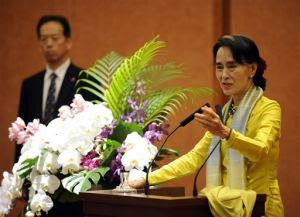
Aung San Suu Kyi delivers a speech at the University of Tokyo on Wednesday.


The Yomiuri Shimbun

Aung San Suu Kyi, the leader of Myanmar's main opposition party, the National League for Democracy, spoke before about 400 students at the University of Tokyo on Wednesday. She said cooperation from her country's military was necessary to propel constitutional revision.

Though Suu Kyi was under house arrest during the rule of the military junta, she said it was important to maintain a good relationship with the military, which holds 25 percent of the seats in the national assembly.

She said young people in Japan were less interested in elections. As those in Myanmar do not really understand democracy, Japanese should be glad they can participate in free and fair elections, she added.

Suu Kyi Says Laws, Infrastructure Stalling Investment in Myanmar

[postlink] https://burmacampaignjapanteam.blogspot.com/2013/04/suu-kyi-says-laws-infrastructure.html [/postlink]

 Aung San Suu Kyi lecture at University of Tokyo


Myanmar opposition leader Aung San Suu Kyi said foreign investment in the newly democratizing nation is being held up by inadequate infrastructure and uncertainty over investment laws.
Speaking to students at the University of Tokyo today, Suu Kyi also said establishing the rule of law was a prerequisite for dialog to end the ethnic violence that has killed dozens of people and displaced thousands in recent weeks.
“Foreign investment is increasing more in theory than in actual fact, because many of the big businesses are waiting to see what our foreign investment laws are going to be like and studying the infrastructure in Burma, which is very poor,” Suu Kyi said, referring to the country by its former name.
Myanmar’s shift to democracy after five decades of military rule has attracted interest from companies including Google Inc., while MasterCard Inc. (MA) last September became the first payments network to issue a license to a Myanmar bank. Chinese and Japanese companies are also investing in the country, which borders India, China and Thailand.
While the lack of basic facilities such as roads, electricity and water supply are causing some companies to delay investments, large food producers may be interested in investing in agriculture, Suu Kyi said.
The former political prisoner is on a week-long visit to Japan, her first in 27 years, during which she has met Foreign Minister Fumio Kishida and will visit Prime Minister Shinzo Abe. Abe this week told a parliamentary committee attended by Suu Kyi that he is encouraging businesses to invest in Myanmar.

Debt Forgiveness

Japan, Myanmar’s largest creditor, agreed last year to settle $6.6 billion in arrears and provide loans to help it repay debt to the Asian Development Bank and World Bank.
In response to a question from a student, Suu Kyi emphasized the importance of the rule of law in enabling a resolution to the deadly anti-Muslim violence that has split the ethnically diverse country in recent weeks.
“We have had no rule of law in Burma for the last 50 years,” she said. “What we have had is the rule of an authoritarian government. There can be no negotiation or exchange of ideas if people do not feel secure.”


To contact the reporter on this story: Isabel Reynolds in Tokyo at ireynolds1@bloomberg.net
To contact the editor responsible for this story: Rosalind Mathieson at rmathieson3@bloomberg.net

11 things to know before visiting Myanmar

[postlink] https://burmacampaignjapanteam.blogspot.com/2013/04/11-things-to-know-before-visiting.html [/postlink]

11 things to know before visiting Myanmar

By Kate Whitehead, for CNN
April 5, 2013 -- Updated 2045 GMT (0445 HKT)


(CNN) -- How do Burmese punks keep their mohawks standing tall?
Why does cash in Myanmar need to be kept clean?
What does making a kissing sound in a Yangon restaurant get you?
As recently as a year ago, few people would have cared about the answers to any of these questions.
But newfound political freedom has brought a surge in tourism to the once isolated country, making Myanmar a 2013 traveler's hot spot, and a place worth getting up to speed on.


New Year celebrations last four days
The Burmese make a big deal of the New Year. Thingyan (known as the "water throwing festival") takes place this year from April 13-16. During the festival everyone throws water at each other. Staying dry isn't an option. Water symbolizes the washing away of the previous year's bad luck and sins. 


1. New Year celebrations last four days

The Burmese make a big deal of the New Year. Thingyan, known as the "water throwing festival," is celebrated in April. This year it takes place April 13-16.
Everything shuts down over the four-day New Year -- banks, restaurants, shops. The biggest celebrations are in Yangon and Mandalay.
During the New Year water-throwing frenzy everyone throws and sprays water at each other. Staying dry isn't an option. Water symbolizes the washing away of the previous year's bad luck and sins.
On New Year's Day, the fourth day of the festival, fish and birds are released as acts of merit and feasts are held for monks.
In recent years of privation, hard-core Burmese punks used leather glue to spike up their hair at New Year. The superstrong glue meant their mohawks stayed standing through the Water Festival, but when the party was over they had to shave their hair. These days, Burmese punks use hairspray.


Myanmar has fantastic beaches 
Along the Andaman Sea, Ngapali Beach is Myanmar's top beach resort area. Much of the surrounding countryside remains undeveloped. Best of all, the sunsets are killer.   


2. Myanmar has fantastic beaches 

Myanmar has 1,250 miles (2,000 kilometers) of coastline and some of the finest stretches of beach in Asia. Many beaches along the Bay of Bengal and Andaman Sea remain undiscovered by tourists and unspoiled by development.
Many of them face west, so they produce great sunsets.
The best known is Ngapali Beach, a 45-minute flight from Yangon, where almost two miles of white sand are lined with palm trees overlooking the Andaman Sea. Here, you'll find a number of large resorts.
Less developed is Ngwe Saung, a beautifully unspoiled beach that's a five-hour drive from Yangon. Also called Silver Beach, its eight-mile (13 kilometers) stretch makes it one of the longest beaches in Asia.


The trains are seriously bumpy
Poor condition of railway tracks means carriages get shaken about. This makes for a bouncy ride, but trains are still a great way to see the country. Myanmar's trains are slow and have a reputation for running late. The most reliable route, Yangon to Mandalay, takes about 16 hours, assuming no delays. 


3. The Internet isn't censored anymore, but it's still slow

The Internet arrived in Myanmar in 2000, but high prices and slow connections mean it's still not widely used.
Under the former government, websites such as YouTube and Gmail were blocked, but restrictions have largely been lifted and last month Google chairman Eric Schmidt visited the country.
Far more popular than the Internet are mobile phones, though here, too, prices are high compared with other Asian countries. Local IT firms are lobbying to introduce cheaper SIM cards and a breakthrough is expected soon.
A U.S.$15 SIM card for mobile phones will be made available in June, in the run-up to the Southeast Asian Games to be held in Myanmar in December, but will be available only to foreigners.


The food is delicious
A typical Burmese meal includes steamed rice, fish, meat, vegetables and soup and all the dishes arrive at the same time. Locals use their fingertips to mold rice into a small ball and then mix it with various dishes.  

4. You'll need plenty of cash -- and make sure it's clean

There are few ATMs in Myanmar, so visitors need to bring plenty of U.S. dollars. The higher the denomination, the better the exchange rate.
Your greenbacks should be squeaky clean -- that means no creases, stains, marks or tears. A note that's folded or even a little worn is worthless in Myanmar.
At present, credit cards are accepted only in five-star hotels and up-market shops and restaurants, usually with a 2-3% fee added to the bill. But this is changing. By the end of the year, credit cards should be more widely accepted.
The local currency is the kyat (pronounced "chat") and U.S.$1 will get you about 882 kyat. The 5,000-kyat note (just less than U.S.$6) is the highest denomination -- be prepared for a bulging wallet.
There's little worry about carrying a lot of cash. Crime against foreigners is rare and the Burmese -- the vast majority of whom are Buddhist -- are generally honest.


Mobile phones trump the Internet
Myanmar has lots of Internet cafes. The connections are just brutally slow. Mobile phones are more popular than the Internet. In June, US$15 SIM cards for mobile phones are expected to be made available to foreigners. 


5. A kissing sound gets you a beer

When the Burmese want to get a waiter's attention they make a kissing sound, usually two or three short kisses. It's the sort of sound you might make if calling a cat.
Walk down 19 Street in Yangon's Chinatown and you'll hear that kissing sound a lot. This narrow, pedestrian-only street is where the Burmese come to drink.
Restaurants line either side of the street and chairs and tables are set out in front.
The local brew is Myanmar Beer and it's cheap -- about 60 cents for a glass of draught.
This is prime people-watching territory and if you keep an eye out you'll spot Yangon's hip-hop royalty on the prowl.
Just don't expect to see any females. Most Burmese women -- married and single -- stay home in the evening. That's not to say Western women aren't welcome. It's understood that foreigners have different customs.


The press is flourishing
After decades under a repressive military regime, the Burmese are showing a healthy appetite for news. In the past, all publications had to submit stories to the Press Scrutiny and Registration Division for approval. Censorship was phased out in 2012 and at the beginning of 2013 the bureau was formally abolished. 

6. Hotels are expensive

Room rates shot up 350% last year, which means that a room that cost U.S.$25 a night in 2011 now goes for almost U.S.$100.
It's a simple matter of supply and demand. Since the country opened up, business travelers and tourists have been packing flights to Myanmar. There are a lot more visitors -- more than a million last year -- but roughly the same number of hotels.
More hotels are on the way, but they take time to build and the hotel shortage is expected to continue five to 10 years. Book accommodation well ahead.
A lot of hotels are renovating and since they don't want to miss out on the visitor boom, they're staying open while upgrading. When making a reservation it's worth checking to see if any work is in progress and, if so, requesting a room away from the noise.


You'll need plenty of clean, new bills
There are few ATMs in Myanmar, so visitors need to bring plenty of U.S. dollars. The higher the denomination, the better the exchange rate. This whole stack of kyat (pronounced "chat") is worth about US$20.


7. The men wear skirts

The traditional Burmese dress is the longyi, a wraparound skirt worn by men and women. Men tie theirs in the front and women fold the cloth over and secure it at the side.
NLD Leader Aung San Suu Kyi is known for her beautiful longyis and tailored tops. Her high-profile appearances have helped boost the popularity of the traditional dress among young women in Myanmar.
As for what's worn underneath, that's a matter of personal preference. In the cities, Burmese men usually wear underwear beneath their longyis when they go out, but at home wear it as the Scots wear their kilts.
In the countryside, underwear is much less common -- for men and women. As one man jokingly put it: "Longyi are great. Free air-conditioning." That's a plus, especially when the summer temperature tips 104 F (40 C).
It's completely acceptable for a foreigner to wear a longyi and can be a conversation starter.


A kissing sound gets you a beer
When the Burmese want to get a waiter's attention they make a kissing sound, usually two or three short kisses. It's the sort of sound you might make if calling a cat. Myanmar's national beer is cleverly called ... Myanmar Beer.  


8. The food is exceptional

It's considered rude to eat with the left hand as this is the hand used for personal hygiene. To spell that out -- the left hand does the job of toilet paper.
So eating -- as well as giving money -- is always done with the right hand.
A typical Burmese meal includes steamed rice, fish, meat, vegetables and soup and all the dishes arrive at the same time.
The Burmese use their fingertips to mold the rice into a small ball and then mix it with various dishes.
As is the norm, Buddhists usually avoid eating beef and the Muslims don't eat pork.
Meals are served with plenty of condiments -- from sweet to savory -- and everyone has their preferred way of customizing a dish.


Hotel rooms are pricey and tough to score
Room rates in Myanmar shot up 350% last year, which means that a room that cost US$25 a night in 2011 now goes for almost US$100. New hotels are being built, but the hotel shortage is expected to continue five to 10 years. Book accommodation well ahead. 


9. The trains are seriously bumpy

The poor condition of railway tracks means carriages get shaken about. This makes for a bouncy ride, but trains are still a great way to see the country.
Myanmar's trains are slow and have a reputation for running late. The most reliable route, Yangon to Mandalay, takes about 16 hours, assuming no delays.
On overnight trains, there's more chance of getting some shut-eye in an upper class seat than in a sleeper. It can get surprisingly cold a few hours after dusk, so it's smart to bring something warm to wear.
Buses are usually a faster option, but they're often crowded. Domestic flights are the most comfortable way to cover long distances and relatively cheap.


The men wear skirts
The traditional Burmese dress is the longyi, a wraparound skirt worn by men and women. Men tie theirs in the front and women fold the cloth over and secure it at the side. Here, a longyi-clad visitor walks inside the Shwedagon Pagoda in Yangon.  

10. Yangon has a newspaper vendor on every street corner 

After five decades under a repressive military regime, the Burmese are enjoying their newfound press freedom and showing a healthy appetite for news.
In the past, all publications had to submit their stories to the Press Scrutiny and Registration Division for approval. Censorship was gradually phased out in 2012 and at the beginning of this year the bureau was formally abolished.
Under the former ruling military junta, Myanmar had a reputation for jailing anyone who dared voice opposition; that included many in the media. Last year was the first year since 1996 that no journalists were jailed.
Burmese journalists who fled the country and were forced to live in exile are slowly returning.
April 1 was a landmark for the country's media. For the first time since 1964, daily newspapers were permitted. It's a big step for press freedom, but there are concerns that some of the popular weekly newspapers will struggle to make the transition to daily circulation.


The people with red teeth aren't vampires
Chewing betel nut is a national pastime. Small street stalls, like this one in Mandalay, selling the palm-sized green leaves are everywhere. The leaves are filled with betel nut, spices and sometimes a pinch of tobacco, then folded and popped in the mouth and chewed. 


11. The people with red teeth aren't vampires

Chewing betel nut is a national pastime. Small street stalls selling the palm-sized green leaves are everywhere.
The leaves are filled with hard squares of betel nut, spices and sometimes a pinch of tobacco and then folded up and popped in the mouth and chewed.
You have to chew a while before you feel the mild narcotic effect of the betel nut.
At about 6 cents a wrap it's a cheap hit, but there's a downside. Not only does betel nut stain your teeth a reddish-brown, the little packages are spat out on the floor when finished -- making for messy sidewalks.
It's also highly addictive.


http://edition.cnn.com/2013/04/05/travel/myanmar-11-things/

Myanmar to open museum in home of late UN Secretary-General U Thant

[postlink] https://burmacampaignjapanteam.blogspot.com/2013/04/myanmar-to-open-museum-in-home-of-late.html [/postlink]

 Photo ; museum opening ceremony(https://www.facebook.com/MyanmaAgeMedia)


By Associated Press, Published: April 6


 YANGON, Myanmar — A home of the United Nations’ first Asian secretary-general, the late U Thant, will open as a museum in Myanmar’s biggest city, Yangon.

Government officials, diplomats and members of U Thant’s family gathered Saturday to unveil the restored home, a two-story yellow villa built in the 1920s.

It underwent a six-month renovation as part of an effort to preserve the colonial-era cityscape of one of Asia’s last untouched cities that has been led by the historian Thant Myint-U, who is U Thant’s grandson.

U Thant was the U.N.’s third chief, leading the world body from 1961 to 1971. He lived in the home prior to becoming secretary-general, while serving as a top adviser to Myanmar’s then-Prime Minister U Nu.

http://www.washingtonpost.com/world/asia_pacific/myanmar-to-open-museum-in-home-of-late-un-secretary-general-u-thant/2013/04/06/17147ab2-9eac-11e2-9219-51eb8387e8f1_story.html
 
Support : Website | Template | Mas Template
Copyright © 2012. Burma Campaign Japan - All Rights Reserved
Template Created by Creating Website Published by Template
Proudly powered by Blogger