Latest Videos from World News By BCJP TV

Monks in Myanmar protest at Bangladesh Embassy over attacks on Buddhist temples and homes

[postlink] https://burmacampaignjapanteam.blogspot.com/2012/10/monks-in-myanmar-protest-at-bangladesh.html [/postlink]


YANGON, Myanmar — More than 100 monks in Myanmar demonstrated Friday at Bangladesh’s embassy to protest recent attacks against Buddhist temples and homes in Myanmar’s South Asian neighbor.

The Buddhist monks staged the protest in reaction to Sept. 30 riots in Bangladesh’s coastal district of Cox’s Bazar. Thousands of Muslims there set fire to at least 10 temples and 40 homes due to anger over a photo of a burned Quran posted on Facebook, allegedly by a Buddhist.

The attacks came as sectarian relations remain tense in Myanmar’s western Rakhine state, where clashes in June between members of the Buddhist community and Rohingya Muslims of Bengali origin left about 90 people dead.
About 300 Buddhist monks in Thailand’s capital, Bangkok, staged a similar protest Wednesday outside the regional office of the United Nations.

Copyright 2012 The Associated Press. All rights reserved. This material may not be published, broadcast, rewritten or redistributed.

The road up from Mandalay

[postlink] https://burmacampaignjapanteam.blogspot.com/2012/10/the-road-up-from-mandalay.html [/postlink]

The road up from Mandalay

In the sticks, the army’s business activities are all too present

AFTER two decades spent punishing Myanmar with economic sanctions, now Western countries cannot seem to ditch them fast enough. Since by-elections on April 1st were won almost entirely by Aung San Suu Kyi's opposition National League for Democracy, earlier caution on this issue has been cast aside. Australia and America have lifted travel and financial restrictions on hundreds of members of Myanmar's establishment. The Americans have also promised to ease sanctions on some business sectors, while allowing in American humanitarian groups. Britain's prime minister, David Cameron, recently in Myanmar, says that the European Union should suspend all sanctions, while maintaining an arms embargo.

The moves reward the government for reforms made so far, and are intended to encourage more of the same. And in lockstep with political progress has come welcome economic news: the introduction of a unified exchange rate for the kyat, Myanmar's currency, and the announcement of plans to set up a stock exchange.

Yet a sense of the challenges Myanmar faces on the way to becoming a proper market economy governed by the rule of law can be had by venturing outside the two big cities. Beyond Yangon and Mandalay, interests opposing change remain deeply entrenched. While Western diplomats worry whether Myanmar's reforms are “irreversible” or not, in the ethnic (ie, predominantly non-Burmese) regions around the country's periphery, it is more a question of whether reform has happened at all.

Take the northern part of Shan state, home to the Shan, Myanmar's biggest ethnic minority. Rich in teak (at least until recently) and minerals, the region is also the main link between Myanmar and China, its biggest trading partner. Up and down the often spectacular road between Mandalay and Muse (the old “Burma Road”) passes a good proportion of the trade between the two countries. The economic corridor that has grown up along the road affords a glimpse into Myanmar's warped and corrupt political economy, one that will be hard to unpick.

Most obvious is the dominant role of the army. Lashio, about 200km (125 miles) from Mandalay, is headquarters to the North-Eastern Regional Military Command, with about 30 infantry battalions. For decades the army, dominated by ethnic Burmese, has fought insurgencies here. In January it signed a ceasefire with the Shan State Army-North, but has already breached it.

On the back of its formal military role, the army has also built up a suffocating economic grip on the region. Across Myanmar, the national army has for years pursued a policy of “living off the land”. Battalions are obliged to become their own farmers and businessmen in order to feed themselves and pay their wages. Signs outside Lashio proudly announce the entrances to the North-Eastern command's enormous farms. All along the road up to Muse are more of the army's various forests and plantations.

This arrangement not only gives the army a privileged place in the local economy. Commanders can also use their troops to extract higher prices from customers. As an illustration, Ye Tun, a member of the federal parliament for the local Shan Nationalities Democratic Party, points to the army's battery-chicken farming business at Lashio. For years soldiers manning checkpoints into Shan state turned back all vehicles carrying chickens, so as to keep the prices of the army's birds artificially high. Mr Ye Tun claims that since he exposed this particular scam in parliament it has now come to an end.

More egregiously, the army remains heavily involved in the large-scale cultivation and sale of opium poppies in the region. After pressure from the United States, Thailand and China to eradicate poppy fields in the early 2000s, the army has since been working with gangs called People's Militia Forces (PMFs) to grow more poppies, farther away from prying eyes.

Again, the army can use its checkpoint soldiers to wave PMF drug shipments through, while choking off supplies from competitors among the local ethnic groups. One Shan lobby group based in Thailand says that the links between army and PMF have become so close that in 2010 seven PMF barons were elected to Myanmar's new parliaments (federal and state) under the banner of the army's proxy party, the Union Solidarity and Development Party. Their big pitch for votes to local farmers was that they would let them grow poppies without fear of persecution.

Most devastatingly, much of the area's teak has been cut down and smuggled over the border to China, often with the help of the army. In the hills near the Chinese border it looks as though someone has taken a giant electric shaver to the landscape, so thorough has been the deforestation. In theory, all private logging was made illegal as far back as 1993. Yet one British NGO, Global Witness, estimates that from 1990-2005 Myanmar lost 18% of its forests—and this in a country that once had four-fifths of the world's teak. The situation has improved a bit. However, only three years ago Global Witness discovered imports of 270,000 cubic metres of logs and 170,000 cubic metres of sawn timber in China's Yunnan province just over the border. Nine-tenths of this timber, from Myanmar, was felled illegally, and army officers presumably helped to hurry the timber over the border.

Many of Myanmar's generals have built fortunes on this kind of ruinous exploitation. Their wealth is much in evidence in Shan state. Swish hotels, shops and even domestic airlines are owned by serving or former military officers.

One former officer who should know a lot about this kind of thing is the current president, Thein Sein. Before he donned civvies to become a reformer, Mr Thein Sein was head of the Triangle Region Military Command from 1997-2001, to the south-east of Lashio. He was rumoured to be close to the drug lords of the local United Wa State Army and is said to have let them steal land from local farmers to allow the army's friends to cultivate poppies on it. Loosening the army's grip on local economies is a condition of lessening its political power. It will have somehow to be done if Myanmar is truly to change.

Suu Kyi praises SA democracy

[postlink] https://burmacampaignjapanteam.blogspot.com/2012/10/suu-kyi-praises-sa-democracy.html [/postlink]


Los Angeles -

Nobel laureate Aung San Suu Kyi wrapped up a landmark two-week US trip praising eastern Europe and South Africa's democratic transitions - but saying Myanmar must find its own path.

The opposition icon, who flies home on Wednesday, said Myanmar has to develop its own form of democracy - one that would probably not be like that of the United States, where a presidential election is only weeks away.

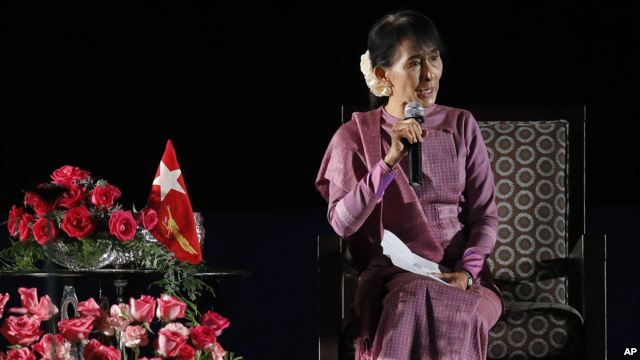
“It can't be like America's democracy because Burma is not America,” she told several thousands supporters gathered on Tuesday in Los Angeles for her last public appearance before she left for home.

“Each country develops its own type of democracy, not something that should be imposed from above. I've always been against so-called disciplined democracy, which has been advocated by the military regime.”

Suu Kyi, who spent 15 years under house arrest until her 2010 release, arrived in the US on September 17 for the visit, which included a meeting with President Barack Obama in the White House.

The 67-year-old, who won the 1991 Nobel Peace Prize - although she only accepted it in person in June of this year - also met in Washington with Secretary of State Hillary Clinton, who visited Myanmar in December.

After meetings in Washington and New York, Suu Kyi travelled to Kentucky and Indiana and visited Yale and Harvard universities, before a public event in San Francisco at the weekend.

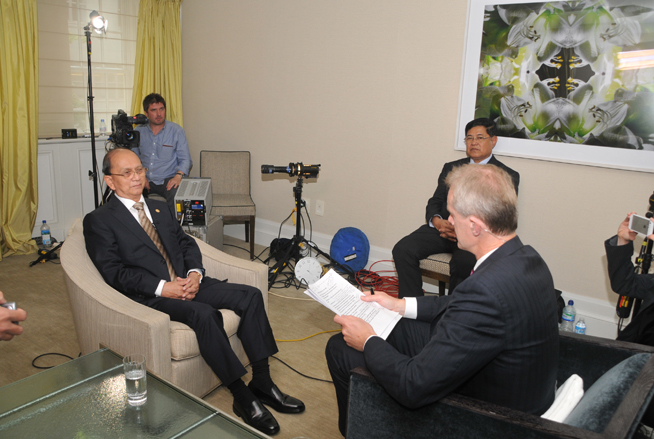
In translated excerpts of a BBC interview that aired Saturday, Myanmar President Thein Sein said he would accept Suu Kyi as president if elected, although he added he could not alone amend rules that bar her from power, including one prohibiting high office for those with close foreign relatives.

Suu Kyi was asked in Los Angeles - where she appeared relaxed and energetic, joking and speaking mostly in Burmese during a 90-minute question-and-answer session - what she would do if she were Burma's president.

She dismissed the question by saying: “You should consider how the present president of Burma is handling the situation, rather than asking me how I would handle it if I were the president of Burma… Let's be practical.”

Asked what democratic models Myanmar could look to, she said: “We have many, many lessons to learn from various places, not just the Asian countries like South Korea, Taiwan, Mongolia and Indonesia.”

She also cited “the eastern European countries, which made the transition from communist autocracy to democracy in the 1980s and 1990s, and the Latin American countries, which made the transition from military governments”.

“And we cannot of course forget South Africa, because although it wasn't a military regime, it was certainly an authoritarian regime.”

She added: “We wish to learn from everybody who has achieved a transition to democracy, and also… our great strong point is that, because we are so far behind everybody else, we can also learn which mistakes we should avoid.”

In a nod to the current deep US political divide between Republicans led by Mitt Romney and the Democrats of Obama - battling to win re-election on November 6 - she stressed the need for compromise.

“Those of you who are familiar with American politics I'm sure understand the need for negotiated compromise,” she said with a smile.

Supporters gave her a rousing reception when she arrived at the LA Convention Center for Tuesday's event, where security was tight - a small group of Muslims protested outside against “genocide” in Myanmar.

“She is very inspirational for us, we admire her,” said Corina

Yang, 36, who is half-Chinese and said it was the first time she had seen Suu Kyi.

Asked if she would make a good president, Yang said: “She's a very straightforward person, and I really like her personality. She is a very honest person, so I really wish her one day to become president in our country.” - Sapa-AFP


Suu Kyi: Burma Must Develop Own Its Democracy

[postlink] https://burmacampaignjapanteam.blogspot.com/2012/10/suu-kyi-burma-must-develop-own-its.html [/postlink]


"Burma is not America" says Suu Kyi at end of US tour

[postlink] https://burmacampaignjapanteam.blogspot.com/2012/10/is-not-america-says-suu-kyi-at-end-of.html [/postlink]
 
Burma's opposition icon Aung San Suu Kyi has paid tribute to models of democratic transition, in a speech wrapping up her US tour. (Credit: Reuters)

Burma's opposition icon Aung San Suu Kyi has wrapped up her two-week tour of the United States.

She said Burma needs to develop its own form of democracy, which would probably not be like that of the United States.
"It can't be like America's democracy because Burma is not America," she told several thousands supporters gathered in Los Angeles for her last public appearance before she leaves for home later today.
"Each country develops its own type of democracy, not something that should be imposed from above. I've always been against so called disciplined democracy, which has been advocated by the military regime."
Ms Suu Kyi was asked what she would do if she were Burma's president.
"You should consider how the present president of Burma is handling the situation rather than asking me how I would handle it if I were the president of Burma . . . Let's be practical," Ms Suu Kyi replied.
The current president, Thein Sein, who was also in the US last week, told the BBC that he would accept Suu Kyi as president if elected.
However, he added he could not alone amend rules that bar her from power.
Democracy tribute
Asked what democratic models Burma could look to, she said: "We have many, many lessons to learn from various places, not just the Asian countries like South Korea, Taiwan, Mongolia and Indonesia."
She also cited "the Eastern European countries which made the transition from communist autocracy to democracy in the 1980s and 1990s, and the Latin American countries which made the transition from military governments.
"And we cannot of course forget South Africa, because although it wasn't a military regime, it was certainly an authoritarian regime."
Warm welcome
Supporters gave Ms Suu Kyi a rousing reception when she arrived at the LA Convention Centre for Tuesday's event, where security was tight.
"She is very inspirational for us, we admire her," said Corina Yang, 36.
"She's a very straightforward person, and I really like her personality. She is a very honest person, so I really wish her one day to become president in our country."

Thein Sein's trip boosts ties with US

[postlink] https://burmacampaignjapanteam.blogspot.com/2012/10/thein-sein-trip-boosts-ties-with-us.html [/postlink]


Myanmar President Thein Sein's week-long visit to the United States, which ended on Sunday, opened a new chapter in the relation between the two countries.
Thein Sein's visit to the country from Sept 24 to 30, which was the first by a Myanmar leader in 46 years, came 18 months after he assumed office in March 2011.
US Secretary of State Hillary Clinton visited Thein Sein at the Mark Hotel in New York. He repeated his dedication to democratic transition, describing the US recognition as an encouragement to the country to continue on its chosen path.
Noting that it was the third meeting between the two, Clinton said that the US is watching the steady reform process implemented by the president and his cabinet and is responding to every step of Nay Pyi Taw to acknowledge the reform efforts and to encourage further reform.
In recognition of the reform process, the US took a step to normalize commercial relations between the two countries by easing US restrictions on the import of goods from Myanmar.
Clinton promised Thein Sein that she would continue to consult with the US Congress and other relevant stakeholders about additional steps.
Clinton also recognized the efforts of the president to bring an end to ethnic conflicts in order to ensure peace and stability in the country.
Thein Sein also held private talks with former US president Bill Clinton and former US secretary of state Henry Kissinger.
He met with members of the Asia Society, as well as leaders of the European Council, the US-ASEAN Business Council and the US Chamber of Commerce.
During the visit, Thein Sein also attended the 67th General Assembly of the United Nations, which was held in New York on Sept 27, where he delivered a speech.
He said that his country will be participating more actively in UN activities in various fields, and will take the challenges of the 21st century in a bold and resolute manner, while standing as a responsible and respectable nation on the world stage.
"Myanmar is now ushering in a new era," he said.
Regarding domestic affairs, he said that Myanmar's parliament, the judicial system, the armed forces, political parties, the civil society, and the people at large have been taking tangible and irreversible steps toward the democratic transition and the reform process.
"Leaving behind a system of authoritarian government wherein the executive, legislative and judicial power were centralized, we have now been able to put in place a democratic government and a strong, viable parliament," he said.
Citing the encouraging and inclusive political process and significant development in the country, Thein Sein said that "the government and other stakeholders have now been able to foster a new political culture of patience and dialogue".
He said that the country's "political progress is enhancing its political legitimacy. This, in turn, facilitates the creation of basic political stability thereby paving the way for economic and social transformation."
In the economic sector, he stressed the need to pay close attention to investments in sectors such as energy to ensure transparency.

Suu Kyi can be president, says Thein Sein

[postlink] https://burmacampaignjapanteam.blogspot.com/2012/09/suu-kyi-can-be-president-says-thein-sein.html [/postlink]


Burma's leader Thein Sein has said in an interview he would accept democracy champion Aung San Suu Kyi as president if elected.


The Burma leader, whose meeting with Ms Suu Kyi in New York marked the latest sign of warm relations between the nation's leader and its most famous former political prisoner, told the BBC that there were "no problems" between them.
"If the people accept her, I will have to accept her. As I said before, we are now working together," he said.
But he insisted that he could not act alone to remove the barriers impeding the democracy champion's route to the presidency, as the country heads towards crucial 2015 elections.
Burma's constitution currently prohibits those with close foreign relatives from holding high office and Ms Suu Kyi, who married a British academic, has two sons living in the West.
"I alone cannot change the constitution. This depends on the wish of the people and also the wishes of the members of parliament," he said.
Thein Sein also underscored the continuing importance of the military, which is guaranteed a quarter of the seats in Burma's parliament.
"The constitution clearly defines the responsibility of the military and every sector of the parliament. We cannot exclude the army from politics," he said.
Thein Sein has won international plaudits - and the suspension or lifting of most Western sanctions - for the fast pace of change in Burma since he took the helm of a quasi-civilian regime last year.
Hundreds of political prisoners have been freed and Ms Suu Kyi - herself locked up for a total of 15 years - has now entered parliament after her National League for Democracy (NLD) party swept key by-elections in April.
Thein Sein, who was a senior figure in the previous junta, has met Ms Suu Kyi on several occasions amid efforts to steer the long-isolated country towards democracy and economic prosperity.
In his address to the United Nations this week, the Burma leader went further than ever in his praise of the veteran activist, whose struggle for change in her impoverished homeland has earned her deep affection both at home and abroad.
"As a Myanmar [Burma] citizen I would like to congratulate her for the honours she has received in this country in recognition of her efforts for democracy," he said.
                    
 
Support : Website | Template | Mas Template
Copyright © 2012. Burma Campaign Japan - All Rights Reserved
Template Created by Creating Website Published by Template
Proudly powered by Blogger